
What Is the Foreign Income and Gains (FIG) Regime?
If you have recently moved to the UK and still earn money abroad — whether from overseas investments, a foreign business, rental income, or savings — you could pay zero UK tax on that income and those gains for up to four years. That is exactly what the Foreign Income and Gains (FIG) Regime is designed to do.
HMRC introduced the FIG regime on 6 April 2025, replacing the old remittance basis of taxation. Under the previous rules, how and when you brought your foreign money into the UK determined your UK tax bill. The FIG regime is simpler and more generous: if you qualify, you can keep your foreign income and gains completely outside the scope of UK tax during your first four years as a UK resident — and you can bring that money to the UK whenever you like, with no additional tax to pay.
Who Is the Foreign Income and Gains (FIG) Regime Relevant To?
The FIG regime is relevant to you if you have recently relocated to the UK and you have income or assets outside the UK. This could include:
- Individuals returning to the UK after living abroad for many years
- Overseas nationals moving to the UK for work or lifestyle reasons
- Entrepreneurs or investors with foreign business interests
- Landlords with overseas property
- Anyone holding foreign bank accounts, shares, or investment portfolios
If any of that sounds like you, read on — this regime could save you a significant amount of UK tax.
Who Qualifies for the Foreign Income and Gains (FIG) Regime?
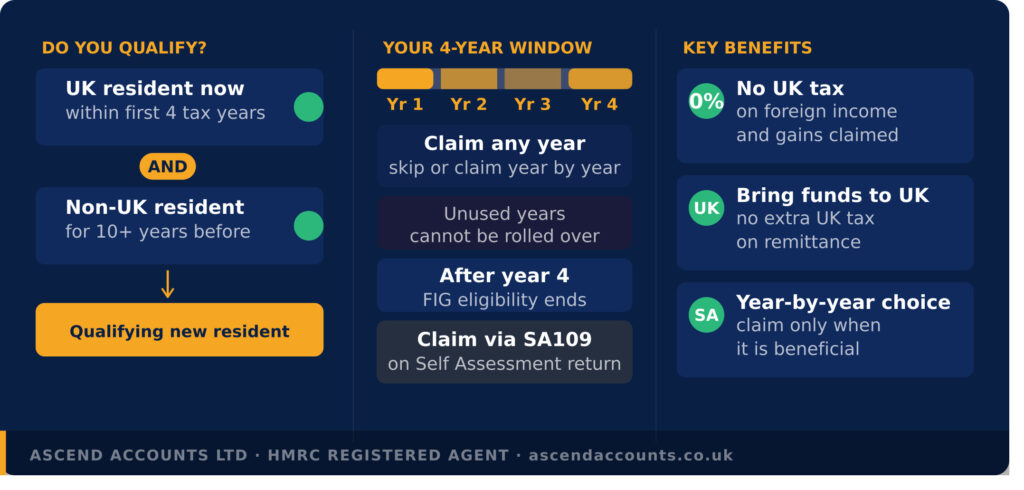
HMRC calls eligible individuals “qualifying new residents.” To be a qualifying new resident, you must meet both of the following conditions:
1. You are in your first 4 years of UK tax residence The FIG regime applies for up to four consecutive tax years, starting from the year you first became a UK resident.
2. You were not a UK resident for at least 10 consecutive tax years before returning You must have spent at least ten tax years outside the UK immediately before becoming a UK resident again. HMRC determines your UK residence status using the Statutory Residence Test (SRT).
There is also one additional rule: members of the House of Commons or House of Lords are not eligible.
What If You Became UK Resident Before 6 April 2025?
You can still use the FIG regime. If your four-year UK residency window started in the 2022 to 2023 tax year or later, you can claim FIG relief from the 2025 to 2026 tax year onwards, up to and including the final year of your four-year window.
A Quick Example
Ama returns to the UK in 2025 after 12 years living in Ghana. She qualifies for the FIG regime. She claims relief for year 1 (2025/26), skips years 2 and 3, and then claims again for year 4 (2028/29). After year 4, her FIG eligibility ends — unless she leaves the UK again for at least 10 consecutive tax years before returning.
What Benefits Does the FIG Regime Offer?
The FIG regime gives qualifying new residents three powerful tax advantages:
1. No UK Tax on Qualifying Foreign Income and Gains
You pay zero UK tax on any foreign income and gains for which you make a claim. This covers a wide range of overseas income, including:
- Profits from a trade or business carried on entirely outside the UK
- Overseas property rental income
- Dividends from non-UK companies
- Interest from foreign bank accounts
- Foreign pension income (with some exceptions)
- Capital gains on foreign assets
2. Freedom to Bring Money to the UK Tax-Free
Under the old remittance basis, bringing foreign money into the UK could trigger a UK tax bill. Under the FIG regime, you can transfer your tax-relieved foreign income and gains to a UK bank account at any time — without any UK tax liability on that transfer.
3. Year-by-Year Flexibility
You do not have to claim FIG relief every year. You can claim in year 1, skip years 2 and 3, and claim again in year 4 if it suits you. However, if you skip a year, you cannot roll it over — unused years are lost.
What Are the Trade-Offs?
The FIG regime is generous, but it does come with some important trade-offs that you need to be aware of before you claim.
You Lose Your Personal Allowance and CGT Exemption
In any year you claim FIG relief, you lose:
- Your income tax personal allowance (currently £12,570)
- Your Capital Gains Tax annual exempt amount (currently £3,000)
- Blind person’s allowance (if applicable)
- Married couple’s allowances and transferable tax allowances
- Certain life insurance payment reliefs
This means the FIG regime is most beneficial when your foreign income and gains are significantly higher than these allowances. If your foreign income is modest, you may actually be better off not claiming and simply keeping your personal allowance.
You Cannot Claim Foreign Losses
In a year you claim FIG relief, you cannot use foreign losses to reduce your UK tax bill. You also cannot carry those losses forward or backward.
Pension Relief May Be Reduced
If you make a foreign income claim, the tax relief available on contributions to a registered UK pension scheme may be limited. The details depend on the source of your income and the amount of relief claimed, so professional advice is essential here.
No Foreign Tax Credit Relief on Claimed Income
If you claim FIG relief on a particular source of foreign income, you cannot also claim Foreign Tax Credit Relief (FTCR) on the same income. FTCR is only available on the portion of foreign income that you have not covered with a FIG claim.
Adjusted Net Income and Child Benefit
Any foreign income for which you claim FIG relief is excluded from your adjusted net income (ANI). This affects your entitlement to tax-free childcare and the calculation of the High Income Child Benefit Charge (HICBC).
What Income Does Not Qualify?
Not all foreign income qualifies for relief under the FIG regime. The following are excluded:
- Foreign employment income and relevant foreign earnings (though you may be able to claim Overseas Workday Relief instead)
- Certain pension income
- Performance income
- Transferred income streams
- Income from certain share exchange arrangements involving non-UK close companies
- Certain income arising under the settlements legislation
If any of these apply to your situation, speak to a tax adviser who can help you identify the best available relief.
How Do You Claim the FIG Regime?
You claim FIG relief through your Self Assessment tax return. Here is how it works in practice:
Step 1: Complete the SA109 supplementary pages These are the “Residence and foreign income and gains (FIG) regime etc” pages. You tick:
- Box 28 to claim relief on foreign income
- Box 29 to claim relief on foreign gains
- Box 30 if you have UK income or gains deemed to be foreign under qualifying asset holding company (QAHC) rules
Step 2: Report and claim relief on the relevant supplementary pages
Depending on the type of income or gain, you will also complete:
- SA103F (Self-employment full) — for overseas trade profits
- SA104F (Partnership full) — for a share of overseas partnership profits
- SA106 (Foreign) — for most types of foreign income, such as dividends and interest
- SA107 (Trusts etc) — for foreign estate income
- SA108 (Capital gains summary) — for foreign capital gains
You must claim relief separately for each source of income. For example, if you have both foreign dividends and foreign interest, you claim each one individually on the SA106 pages.
Step 3: File on time
You have until 31 January following the end of the relevant tax year to file your return, and a further 12 months after that (to 31 January the year after) to amend your claim if needed.
For the 2025 to 2026 tax year, the filing deadline is 31 January 2027, and the deadline to amend a FIG claim is 31 January 2028.
Is the FIG Regime Worth Claiming?
The FIG regime can be a significant tax planning opportunity — but it is not automatically the right choice for everyone.
It works best when your foreign income and gains are large enough to outweigh the loss of your personal allowance and CGT exemption. It also requires careful consideration of your pension contributions, childcare entitlements, and any foreign losses you may want to use.
Before you make a claim, it is worth running the numbers with an experienced UK tax adviser to confirm the net position.
How Ascend Accounts Ltd Can Help
At Ascend Accounts Ltd, we work with individuals who have recently moved to the UK and need help understanding their UK tax position. Whether you are a returning UK national or relocating from abroad, we can help you:
- Confirm whether you qualify as a qualifying new resident under the Statutory Residence Test
- Analyse your foreign income and gains and calculate whether a FIG claim is beneficial in your specific circumstances
- Identify any disqualified income or gains that fall outside the regime
- Prepare and file your SA109 and all relevant supplementary pages accurately and on time
- Advise on the interaction between the FIG regime and pension contributions, childcare entitlements, and Foreign Tax Credit Relief
- Help you plan across all four years to maximise your tax position
We are a London-based HMRC Registered Agent with over 13 years of UK tax experience. We offer transparent, fixed-fee pricing so you always know what you are paying.
Ready to find out if the FIG regime applies to you?
Get in touch with us today.